eMAR vs paper MAR: what actually changes for an assisted living facility
The medication administration record is one of the documents a surveyor reads most closely. On paper it is a monthly grid per resident: one row per medication and time, one box per day, initialled by whoever gave the dose. An electronic MAR, or eMAR, keeps the same record but builds it from what staff do during the med pass instead of from what they write afterwards.
Here is what changes when a facility moves from paper to an eMAR, and what to plan for.
What a paper MAR gets wrong
- Blank boxes found too late. A missed initial is usually discovered during a month-end review, when nobody can say whether the dose was given.
- Handwriting and transcription. New orders are copied onto the MAR by hand, and every copy is a chance for a wrong dose or time.
- No reason recorded. A circled box says a dose was not given. It rarely says whether it was refused, held, or the resident was out.
- One copy. The binder is on one cart. The nurse on the phone with a physician cannot see it.
What an eMAR changes
The pass shows what is due, and what is late
Instead of reading across a grid, staff see the doses due now, the ones past their window, and what is coming later in the shift. A late dose is visible during the shift, while it can still be given or explained.
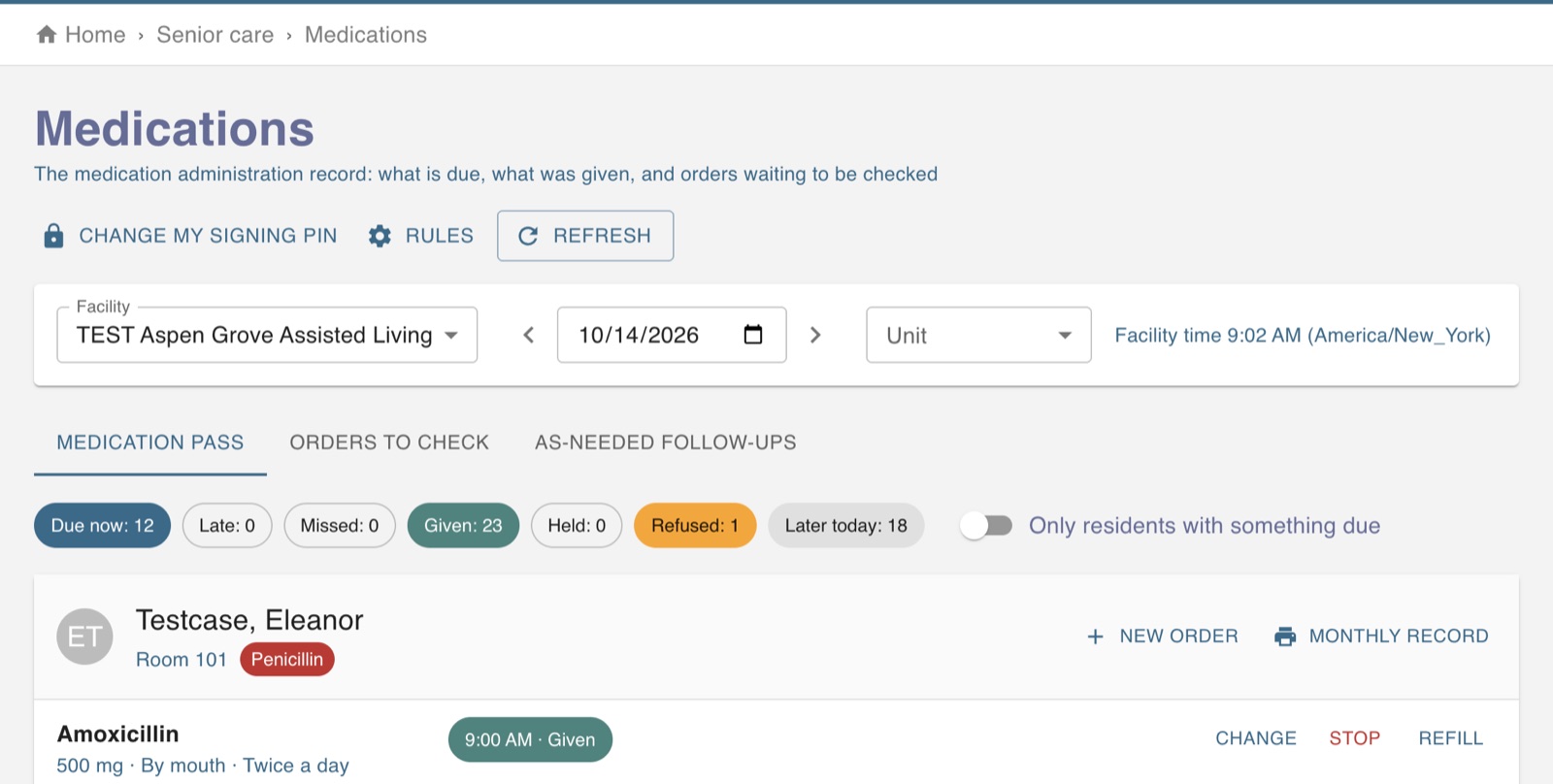
Every dose is signed by a person
Each entry is recorded against the staff member who gave it, usually confirmed with a personal signing PIN. Initials on paper can be ambiguous; a signed entry is not.
A reason for every dose not given
Held, refused, resident away: the eMAR asks why, so the record explains itself when it is reviewed weeks later.
Orders are checked before they reach the pass
New and changed orders can be set to need a nurse's check before they appear on the pass, and stopped orders are flagged so they are not given out of habit.
The monthly MAR still exists
An eMAR does not remove the grid surveyors and families recognise. It generates it, with codes and the staff legend, from what was charted. Nobody copies it by hand.
An eMAR supports your nursing judgement and your state's rules; it does not replace them. Check your state's assisted living regulations for what your MAR must contain and who may administer or assist with medications.
How to switch without a bad first month
- Start at the beginning of a month. A clean break makes the first electronic MAR complete.
- Enter and double-check every active order before go-live, ideally with a second nurse.
- Train on the med pass itself, not on screens. Walk a real pass on a quiet shift first.
- Give everyone their own signing PIN on day one. Shared logins undo the point of the change.
- Review late and missed doses daily for the first two weeks, then weekly.
- Keep the paper MAR for the transition month in your records, as your policy and state require.
See an eMAR built for assisted living
Worktrim's eMAR sits next to ADL charting, vitals, incidents and resident billing, on the same login your staff use for their schedule and time clock.
Book a demo → See the eMAR